
How I Scope a SaaS MVP So It Can Actually Ship
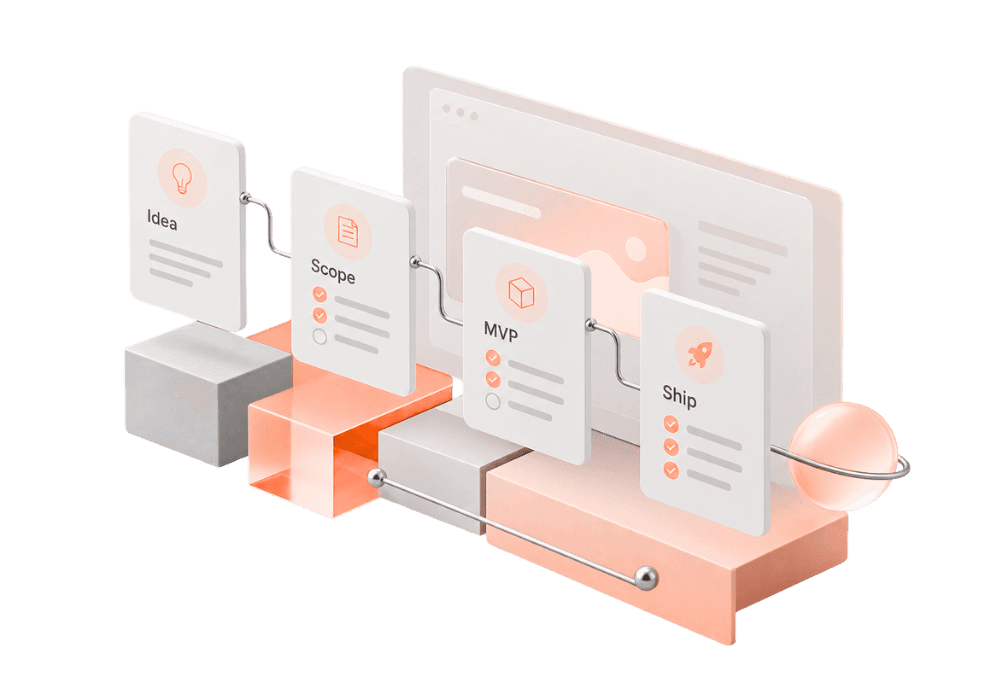
Table of Content

How I decide what belongs in a SaaS MVP, what waits, and what has to be trustworthy before the first version ships.
I rarely see a first SaaS version stall because the idea was empty. I see it stall because v1 tries to be the whole product at once — every role, every edge case, every “nice to have” from the whiteboard.
I scope SaaS and web MVPs the other way: start from the job someone must finish, subtract until that job is unmistakable, then ship a thin slice real enough to learn from — not a landing page around a dashboard shell.
This essay is that judgment: what belongs in v1, what I defer, and what must already be trustworthy so the product can ship — not pricing, timelines, or hire-vs-agency advice. Those are separate questions.
What “MVP” Usually Gets Wrong
In practice, “MVP” often means as many features as the budget can carry. That produces a feature pile: auth, billing, admin, notifications, analytics, multi-tenant fantasy, onboarding tours — and still no single workflow a stranger can finish without a walkthrough.
The other failure mode I watch for is a demo that looks finished and collapses the moment someone tries to do real work. Polished chrome around an empty job is still empty.
What I want from a first version is narrower. One primary user. One important job. Enough structure that the job is trustworthy — not so much that the job disappears. If I cannot say the job in one sentence, the scope is not ready.
How I Decide What Belongs in v1
I start with a job-to-be-done question, not a feature list: What must someone complete so this product earns a second visit?
Everything else sorts relative to that answer. I keep inputs that make the job possible. I keep states that make the result believable. Secondary configuration, decorative settings, and “we will need this when we scale” architecture usually wait.
Before I add anything, I ask what the product can stop promising for now — multi-role permission matrices, marketplace ambitions, every integration that might someday matter. Those ideas are not wrong. They are wrong first. A v1 that tries to be fair to every future version is unfair to the one that has to ship.
I prefer a vertical slice over a horizontal one: one workflow all the way through — clear entry, clear action, clear outcome — rather than five half-finished areas. Horizontal stubs look like progress in a backlog. Vertical slices look like progress to a user.
Weekly demos help as a forcing function, not theater. If we cannot show the job getting done, we are still organizing work instead of finishing it.
When I prioritize, I ask whether each item serves the one job, competes with it, or can wait — not whether it fills a framework sheet.
I also keep three decisions separate when feature lists blur them:
- Belongs in v1 — required for the primary job end to end.
- Deferred — valuable later, wrong now, named so it does not sneak back in.
- Trustworthy for this product — not a universal checklist. Depending on the product, v1 may still need reliable errors, durable saves, basic access control, or careful webhooks and failure handling when money, messages, or irreversible actions are involved.
I do not treat deployment hygiene, backups, or monitoring as a second product beside the MVP. I treat them as support for the job we chose. A thin workflow that loses work or fails silently is not a scoped MVP — it is an unfinished promise. Before ship I ask: Can someone finish the job and trust the result?
Honest Boundaries — What I Defer
Scoping is only credible if the deferrals are named out loud.
I often defer auth polish that does not change whether the core job works — invitation edge cases, elaborate profiles, SSO before anyone has asked. Account basics can be enough early; ceremony can wait.
I defer multi-tenant fantasy until tenancy is a real requirement, not a slide. Per-org branding engines and role trees for imaginary teams burn weeks that should have gone to the workflow.
I defer billing complexity when the product has not yet proved anyone will pay for the job. A clean path to charge later is useful. A full pricing matrix and dunning suite on day one usually is not.
I defer admin surfaces that exist only to make the builder feel in control. If operators do not need a panel to complete the primary job, the panel is not v1.
None of that means “never.” It means those pieces earn their place after people can finish the job. Honesty about boundaries is part of how I work on SaaS & Web and Full-Stack engagements — scope that ships beats scope that impresses a spreadsheet.
One Workflow — Clarity as the Real Test
The real test of an MVP is not the length of the roadmap. It is whether one workflow feels obvious under use.
I lean on that lesson from Tool Matrix, my 2024 university Final Year Project — as an analogy for workflow clarity, not as a claim that it was a billed SaaS MVP. It is a calculation toolkit I designed and built: messy multi-step math turned into a clear browser UI with less noise, obvious inputs, and results you can trust. Complexity there meant one kind of work done well.
That is still the right bar for v1 thinking. Name the job. Make the path readable. Remove anything that competes with the next useful action. If the primary workflow needs a guided tour, the interface is carrying unfinished scoping — not unfinished marketing.
I wrote more about that standard in Designing Clarity Into Complex Tools. For SaaS scoping the point is simpler: if one workflow is not clear, more features will not rescue it. They will hide the problem under volume.
Design and Frontend as One Owner
Scoping decisions die quietly when design and frontend are separate handoffs. A mock can look “MVP-ready” and still ship as a different product once spacing, states, empty views, and error paths get improvised in code.
When the same person owns judgment and the interface that carries it, subtractive choices survive implementation. Labels stay plain. Secondary options stay secondary. The primary path does not pick up decorative weight because someone else finished the frame in Figma.
That single-owner loop is how I prefer to ship product UI — including Product UI/UX work beside SaaS builds. Early products often need fewer translators and more people who cut scope in the same pass as they cut pixels.
When Founders Need SaaS & Web Help
If you are staring at a backlog that feels like three products, more velocity is usually the wrong first fix. What helps is a sharper v1: one job, honest deferrals, a vertical slice someone can finish without a walkthrough, and enough trust that the result is worth keeping.
That is the ownership I take on for select remote projects — SaaS and web products end-to-end, without an agency layer between you and the person writing the code. See SaaS & Web, with Full-Stack and Product UI/UX supporting the same ship-ready standard. For workflow clarity under complexity, start with my FYP, Tool Matrix.
I work as a Senior Lead / Full-Stack Product Engineer based in Faisalabad, Pakistan. If you want help scoping and shipping a first version that can learn in the wild, get in touch.
Roadmaps can look complete. A product only starts when someone can finish the job.