
Freelance Developer vs Agency vs In-House: Who Should Build Your SaaS MVP?
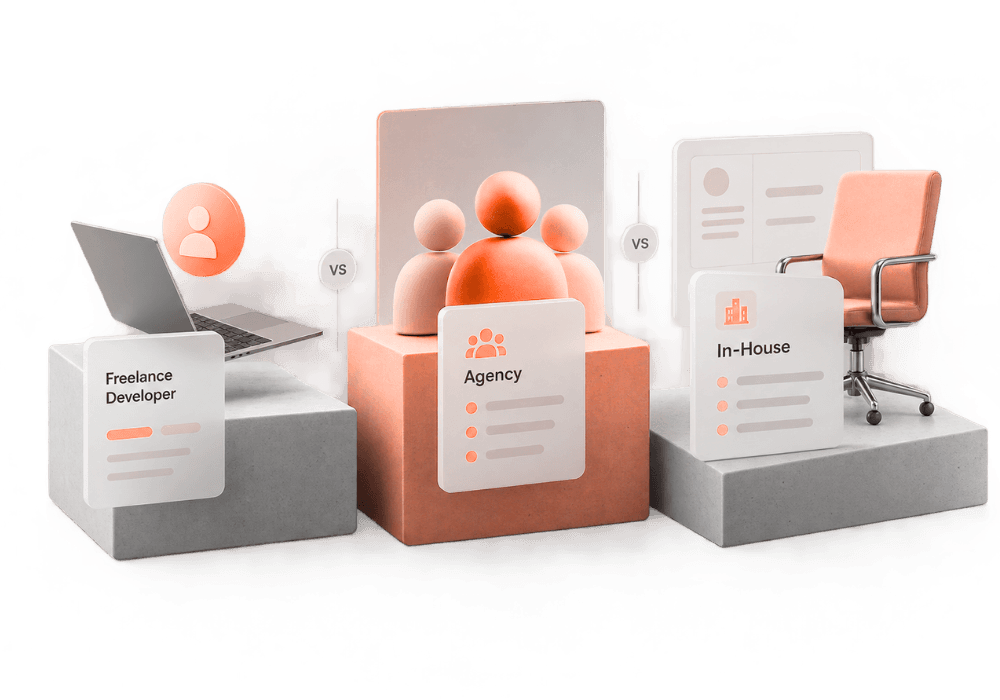
Table of Content

No winner, no scorecard. A practitioner's guide to choosing between a senior individual developer, an agency, and an in-house team for your SaaS MVP — including the questions that matter after launch.
You've decided to build the MVP. The next decision — who builds it — will shape the project more than most founders expect. Not just the next three months, but what comes after: who maintains it, who owns the code, how easily it can be handed to someone else, and how much of your own time the whole thing consumes.
Most comparisons frame this as a price question. It isn't one — or at least, not only one. It's a decision about risk, coordination, and continuity: who absorbs the management overhead, who makes product decisions on the days you're unavailable, and what your options look like six months from now.
This article compares the three common models — a senior individual developer, an agency, and an in-house team — without declaring a winner. Each one is the right answer in some situations and the wrong one in others. What follows is the tradeoffs, and how to match them to your situation.
Why the delivery model matters
The delivery model decides three things that outlive the build itself.
First, who owns the next decision. Every MVP generates a stream of small product and technical decisions — what to cut, what to harden, what to revisit later. Someone has to make those calls with enough context to make them well. The model you choose determines whether that person is you, a project manager relaying your instructions, or the person writing the code.
Second, who absorbs coordination. Building software is integration work: design has to meet engineering, frontend has to meet backend, third-party services have to behave. That integration happens somewhere. Either you do it, a project manager does it, or one person holds enough of the stack in their head that there's less to integrate.
Third, what your options look like after launch. An MVP is a starting point, not a finish line. The code, the documentation, the access credentials, and the working relationship you end up with determine whether month four is "keep building" or "start over."
1. The three common ways to build a SaaS MVP
A senior individual developer. One experienced person who takes the product from idea to a working, deployed application — product decisions, UI/UX implementation, frontend, backend, database, integrations, and deployment.
By "freelancer" here, I don't mean a marketplace developer taking isolated tickets. I'm specifically referring to a senior individual developer who can take substantial ownership across product, UI/UX implementation, and engineering. That distinction matters: the relevant variable isn't freelance vs. employed, it's whether one senior person can hold the whole product in their head. Not every freelancer offers this — the ones who do are a distinct option from both the ticket-taker and the agency.
This is the model I work in, so I'll be specific about its tradeoffs below.
An agency (or product studio). A team sold as a package: typically a project manager, designers, developers, and QA, with an account layer between you and the people doing the work. You buy breadth and process.
An in-house team. Your own hires — employees or long-term contractors who work only on your product. You buy long-term ownership and accumulated context, and you pay for it in hiring time, salaries, and management.
2. What actually changes between the three
Forget the feature lists for a moment. Here's what genuinely differs.
Coordination. With a senior individual, coordination between disciplines stays minimal — the same person makes the product call, implements the UI, and wires the API. The coordination that remains is between you and that person. With an agency, a project manager absorbs coordination internally, which is real value — but you also inherit a second coordination surface: you coordinate with the PM, who coordinates with the team. With an in-house team, you are the management layer, full-time.
Ownership. The question is who feels responsible for the product working, not just for their tickets being done. A senior individual working on one product at a time can own outcomes end to end. With an agency, ownership and responsibility are shaped heavily by the contract, scope, and delivery structure — which is why the quality of the specification and the contract terms matter so much. With an in-house team, long-term product ownership depends heavily on who you hire, how the team is structured, and how it is led.
Communication. Direct with an individual: you talk to the person writing the code, which reduces the chance of context degrading through relays. Layered with an agency: you tend to get polished updates, but the people making micro-decisions can be two removes from you, and those micro-decisions compound. In-house sits wherever your management puts it.
Decision-making. Speed of decisions tends to follow the number of people who need to agree. A single senior owner can reduce the number of people involved in routine product and technical decisions. An agency decides through its process — account manager, tech lead, sometimes a change-order form. In-house decides at the speed of your own clarity as a manager.
None of these is inherently good or bad. They're costs and benefits that land differently depending on your situation — which is the subject of the rest of this article.
3. Senior individual developer
Strengths. A single point of ownership becomes possible: one person can be responsible for the product working, which reduces the gaps where tasks fall between roles. Direct communication, with far less risk of the telephone game. Fast iteration when the scope is clear, because there's no need to schedule across a team. And when the same person handles product thinking, UI/UX implementation, and engineering, design and code stay aligned without handoff documents — the alignment happens in one head.
Tradeoffs. One person has one person's capacity and availability. If they get sick or take a holiday, progress pauses — there is no bench. Breadth has limits: one person can be genuinely strong across the full stack while still not being a specialist designer, a security auditor, and a DevOps engineer at the same time. And some of the project management falls to you: you'll need to be available for decisions and feedback, because there's no PM buffering your absence.
The bus factor, answered concretely. This is the objection every comparison raises about solo developers, and it deserves a real answer rather than dismissal. The risk is real; it's also mitigable. Here are the safeguards worth asking for — and it's reasonable to expect a senior individual to propose most of them unprompted:
- Prefer keeping the repository in your own GitHub organization from the first commit — not in a personal account slated for "transfer later."
- Make sure hosting, domain, and third-party service accounts are created in your or your company's name, with the developer added as a team member.
- Consider milestone-based payments tied to working, deployed increments rather than large upfront sums.
- Ask for a short written record of key architecture decisions as the build progresses — not a novel, just enough that another developer can orient in a day.
- Favor a mainstream, well-understood stack, so bringing in another developer later is straightforward rather than an archaeology project.
- Agree on handoff expectations upfront: what "done" includes and what happens if the engagement ends early.
If a freelancer resists any of these, that's information. If they propose them before you ask, that's also information.
Ownership and documentation. Ask who writes documentation and when. The honest answer for an MVP is: lightweight, continuous, and decision-focused — an architecture overview, setup instructions, and a credentials inventory — rather than a wiki nobody maintains. What matters most isn't volume; it's that a competent developer could take over without a forensic investigation.
When a senior individual developer can be practical. When the product is focused enough for one person to hold — which describes many MVPs. When you, the founder, can stay involved for decisions and feedback each week. When you value speed and flexibility over process — the ability to change direction on Tuesday without a change-order meeting. And when you want direct access to the person making the technical decisions, because those decisions compound into the product's future.
4. Agency
Strengths. Breadth: design, engineering, QA, and project management moving in parallel, which matters when the scope genuinely needs multiple specialists at once. Process: estimation, standups, QA passes, and structured delivery — useful if you have no one internally who can evaluate the work as it happens. Continuity: if one developer leaves, the agency can usually replace them and keep the project moving. An established agency may also provide an existing delivery process, specialist coverage, and project-management structure.
Tradeoffs. You're paying for coordination as well as production — the PM layer, the account management, and the process overhead are all in the invoice, and for a focused MVP that overhead can exceed the value it adds. You typically get less direct access to the people writing the code, which means product micro-decisions can get made at a distance from you. Change can be expensive: fixed-scope contracts handle pivots through change orders, and MVPs pivot. And quality varies enormously between agencies — "agency" describes a business model, not a quality tier. Ask who will actually write and review your code.
When an agency genuinely makes sense. There are situations where an agency is the right call, and they're worth stating plainly:
- Parallel workstreams. Your MVP needs serious product design, backend engineering, and QA happening simultaneously, on a timeline one person can't cover.
- Compliance or auditability requirements. Regulated data, security reviews, SOC 2 or GDPR processes — agencies that do this repeatedly may already have the relevant processes and specialist coverage.
- A hard, immovable deadline with scale. Launch tied to funding, a partnership, or an event, where you need multiple people working in parallel.
- No technical reviewer on your side. If no one on your team can evaluate code quality or push back on technical decisions, an agency's internal review process can provide an additional layer of technical oversight.
- Long-term partnership intent. If you expect to keep buying design and engineering capacity for a year or more, an agency's broader team structure may fit that ongoing need.
The common thread: agencies make sense when you need a team, with everything that word implies — including its cost.
5. In-house team
Strengths. Long-term ownership: the people who build it maintain it, and product knowledge accumulates instead of walking out the door at the end of a contract. Availability: your team works on your priorities, not a client's queue. Context: over months, an in-house team develops judgment about your product that external parties rarely match. And cultural alignment, to the extent you build it deliberately.
Tradeoffs. Hiring often takes months, and hiring well takes longer — particularly hiring senior full-stack engineers before the product exists to attract them. You're buying management overhead permanently: 1:1s, career growth, retention. For a pre-PMF MVP, there's a real risk of building the team before you've validated what the team should build. And the cost structure is fixed: salaries continue whether the roadmap is full or not.
When an in-house team makes sense. When you're past the validation stage and iterating regularly on a product with traction. When the product is the company — the core competitive advantage lives in the software and the team that builds it. When you have technical leadership in place (a CTO or founding engineer) who can hire and lead well. When you're funded with enough runway that a hiring cycle doesn't threaten the company's existence.
One practical transition pattern is to use an external builder for the MVP, then hire the first internal engineer before the external engagement ends, so there's overlap. The new hire learns the codebase from the person who wrote it, instead of inheriting it cold. More on this below.
6. The questions founders should ask before choosing
Regardless of which model you're leaning toward, get crisp answers to these before signing anything:
- What happens after the MVP? Who continues development, under what arrangement, starting when? If the answer is vague, the decision isn't finished.
- Who owns the code — specifically? Not "you own it" in the abstract: whose GitHub organization holds the repository, from which commit? Establish this in the contract, not in conversation.
- Who owns the IP? Is there a written assignment of work product to you or your company? What about pre-existing libraries or boilerplate the builder brings — is background IP addressed in writing? This is worth a lawyer's hour, not just a contract template.
- Who maintains it in month four? Bug fixes, dependency updates, monitoring — is that included, a retainer, or your problem? Get the answer in writing.
- What happens if one person leaves? For an individual: the safeguards in section 3. For an agency: who replaces them, and how is context transferred? For in-house: what does your own bus factor look like?
- How much of my time does this need? Be honest about your availability for decisions, feedback, and coordination. Then match the model to the answer: limited founder time favors whoever needs you least — often an agency's PM layer or a senior individual with clear scope — rather than several contractors you have to integrate yourself.
- How much product and design involvement can I give? If you can't, you need whoever supplies it: an agency's design capacity, or an individual with genuine product instincts — not just ticket execution.
7. What happens after the MVP?
This is the section most comparisons skip, and it's where the delivery-model decision keeps billing you.
Continued development. MVPs that find traction often need continued work after launch. Plan the next phase before the first one ends: is the same builder continuing, is someone new taking over, or are you hiring? "We'll figure it out after launch" is how codebases become unmaintainable — not through bad code, but through ownership gaps.
Maintenance. Someone has to watch error tracking, update dependencies, renew certificates, and respond when something breaks at 2 AM. Clarify whether your arrangement includes this, and for how long — in the contract. One arrangement founders use is a small monthly retainer; another is handing maintenance to the first hire.
Hiring your first engineer. If the plan is to bring development in-house eventually, the highest-leverage move is overlap: your new engineer starts while the original builder is still engaged. A handoff to an empty seat — "here are the docs, good luck" — is abandonment with a nicer name. A planned overlap period can make the transition substantially easier than handing over documentation after the original engagement has already ended.
Documentation as a handover surface. What matters most isn't comprehensive documentation but the specific artifacts a new developer needs: how to run the project locally, where secrets live, the architecture overview, the deployment pipeline, and the list of third-party services with their owners. Agree on this list upfront, whatever the model.
The two-jobs problem. A validation MVP and a production system are different jobs, and the transition between them is where technical-debt conversations get real. Whoever built v1 should be able to tell you honestly what was built to learn versus built to last — auth, data model, and integration patterns are where shortcuts tend to surface first. Ask for that assessment explicitly at the end of the engagement.
8. A practical decision framework
No scores, no winner — just situations mapped to what deserves your attention.
"I have a focused scope and can stay involved weekly."
Consider a senior individual. Pay attention to: the bus-factor safeguards in section 3, repo and account ownership from day one, and whether their product judgment — not just coding speed — is evident in conversation.
"I need design, engineering, and QA moving in parallel on a fixed deadline."
An agency may fit. Pay attention to: who actually writes the code, how change requests are priced, and how much direct access you get to the technical team.
"We're funded, have traction, and iterate regularly."
It's usually time to start building in-house. Pay attention to: hiring a technical lead first, and consider a bridge builder for the MVP so you're not hiring against a deadline.
"I'm non-technical and no one can review the work."
You need whoever supplies the missing judgment: an agency's internal review process, or a senior individual engaged through a small paid trial milestone first — then have an independent developer review the output before committing further.
"I expect to hire in-house within six months."
Optimize for handover from day one, regardless of model: your accounts, your repo, a mainstream stack, documented decisions, and a planned overlap period.
"My scope keeps changing and I need to pivot fast."
Favor the arrangement that changes direction with the least friction and cost: often a senior individual on a time-boxed arrangement — or an agency only if their change process is genuinely lightweight. Verify that with a reference, not the sales deck.
9. Conclusion
There is no universally cheapest or fastest option — only cost structures and risk profiles that fit different situations. The right question isn't "which model is best," it's "which model matches my product's stage, complexity, ownership needs, and what comes next."
If you're early, focused, and can stay involved, a senior individual can give you direct ownership and speed. If you need parallel specialists, compliance machinery, or a hard deadline at scale, an agency's breadth may earn its overhead. If you're past validation and the product is the company, build the team.
Whichever you choose, decide the after-MVP plan before the MVP starts. The delivery model is a bridge to whatever comes next — make sure you know what's on the other side.
I'm Taha Umar, a Senior Lead / Full-Stack Product Engineer based in Faisalabad, Pakistan, working remotely with founders and teams. If you're deciding how to build an MVP, I work as a senior individual engineer across product thinking, UI/UX implementation, and full-stack engineering — you can see how I approach SaaS & web projects, read how I scope a SaaS MVP so it can actually ship, or get in touch to discuss your product.